
The ELI Weekly
Volume 161, Issue 3 – September 14, 2026
Out and About: St. Augustine, Florida
On September 19th, ELI students can visit the beautiful coastal city of St. Augustine, FL! This historic city is a favorite for visitors for many reasons: its beaches, colonial architecture, rich history, cultural heritage, great restaurants, shopping, and all-around good vibes!
Do you want to know a little more about St. Augustine before you visit? Here is a short history:
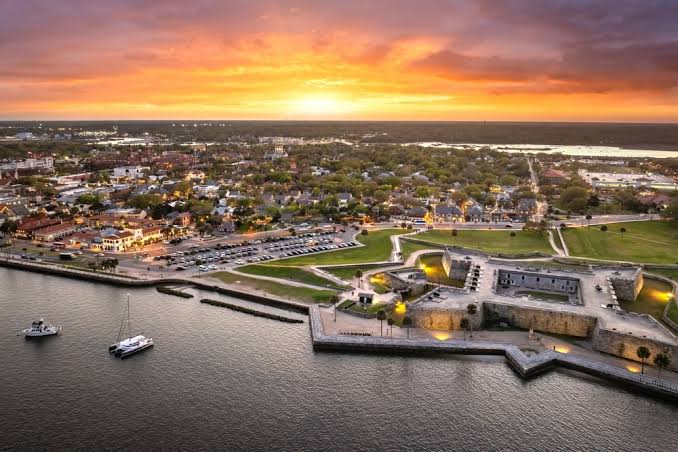
St. Augustine is the oldest, continuously inhabited European settlement in the United States. On September 8, 1565, the Catholic feast day of St. Augustine, Pedro Menéndez de Avilés claimed St. Augustine for the Spanish crown, and it remained a base for the Spanish military and Catholic missionaries for 200 years, after which it was conquered by the British. With Britain in charge, nearly all Spanish residents and soldiers evacuated to Cuba.
British rule of St. Augustine lasted only 20 years, from 1763 to 1783, but many changes occurred during this time. The British established plantations, declared Protestantism the official religion, and divided the Florida territory into two parts: East Florida, with St. Augustine as the capital, and West Florida, with Pensacola as the capital. When the American Revolutionary War broke out, British loyalists in the 13 colonies fled to St. Augustine.

After the American colonies defeated the British, St. Augustine returned to Spanish control. However, Spain ceded St. Augustine to the United States in 1819, as part of a treaty that allowed Spain to maintain control over Texas.
During the American civil war, St. Augustine was the only city in the southern United States to order an immediate release of all slaves when Abraham Lincoln signed the Emancipation Proclamation. All slaves in St. Augustine became free citizens and established a community known as Lincolnville, in honor of Abraham Lincoln. Lincolnville became became a central site for the Civil Rights Movement in the 1960s.
Today, St. Augustine is popular tourist spot, which combines its fascinating history with its natural beauty.
CIP Weekend Activity

Saturday September 19th – St. Augustine Beach and Town – 8:15am-9:15pm
Spend a full day with the ELI exploring St. Augustine! We will spend time at the beautiful beach before heading to the historic town of St. Augustine, the oldest city in the United States! Expect a full day of fun and sun! Please read all the information below:
Tickets and Self-Drivers
Tickets for transportation are $25 exact cash. They are on sale now from Christine in the ELI office Monday through Thursday during your lunch hour. Get your tickets before spaces sell out!
If you find a ride with someone else, please offer to pay them $25 because that is around how much it will cost for mileage and parking per person. If you are a self-driver or plan on riding with someone else, please email or text Mathis so he knows to expect you on the trip! Make sure to follow the ELI schedule listed below.
What to Bring
- Bathing suit (It is suggested to wear your suit under your clothes to save time changing when we arrive at the beach. We have a tight schedule and bathroom space is limited. In the past, students have felt that waiting in lines at the bathrooms took too much of their time.)
- Sunscreen
- Towel
- Packed lunch and snacks
- Sports balls/games/beach supplies you might like to have on the beach
- Water
- A change of clothes (for walking around the town)
- An umbrella (just in case if it rains)
- Money for dinner and shopping
September 19th St. Augustine Trip Schedule
Make sure to follow this schedule. It is subject to change. If anything changes on the day of the trip Mathis will let you know.
- 8:15am – Meet at Norman Parking Garage – DO NOT BE LATE
- 10:30am – Arrive to Anastasia State Park Beach (1340 Jimmy Buffett Mem Hwy, St. Augustine, FL 32080)
- For self-drivers: Park in the lot near the Island Beach Shop and Grill and use that beach access. Entry to the state park is 8 dollars per car.
- 2:00pm – Change, rinse off, and gather things to leave.
- 2:30pm – Leave beach for St Augustine Old Town (1 Cordova St, St. Augustine, FL 32084).
- For self-drivers: This is the Historic Downtown Parking Facility. Parking is 20 dollars.
- 3:00pm – Arrive to Old Town
- GET DINNER DURING THIS TIME
- 7:30pm – Leave Old Town to return to Norman Hall – Return to Parking Garage at this time. Do not be late.
- 9:15pm – Arrive to Norman Parking Garage – Please arrange for a ride home at this time.
CIP Photo of the Week
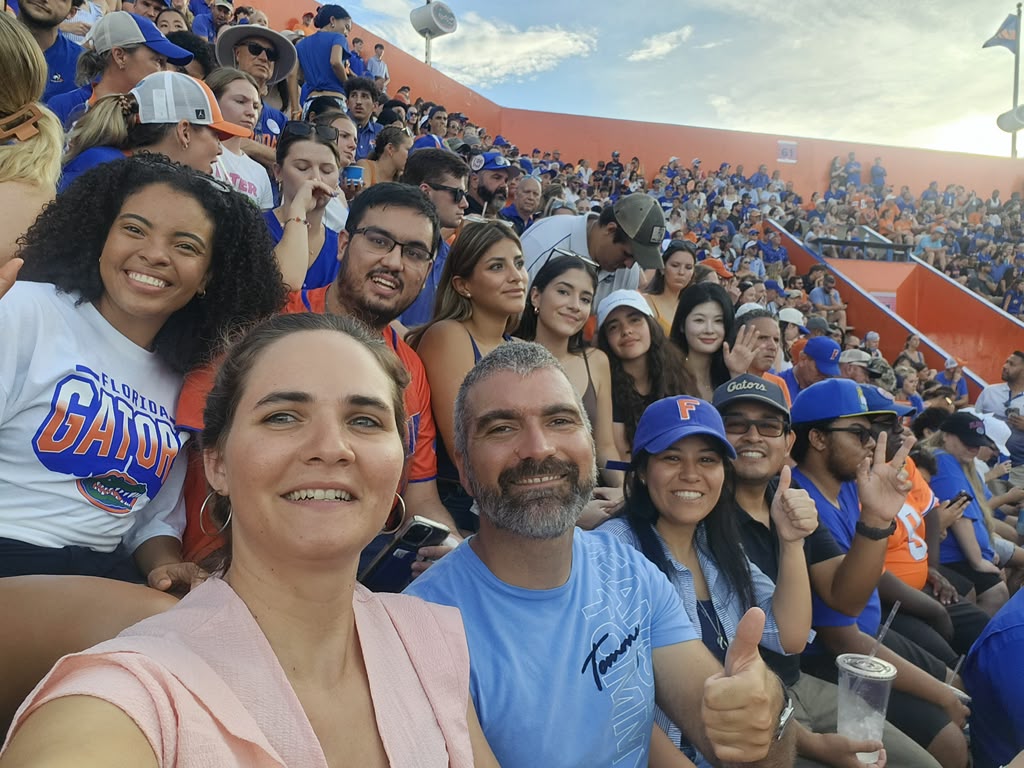
CIP Weekday Activities
| Monday, September 14th – Coffee Talk at Pascal’s – 3:00-5:00pm | *Note Coffee Talk is at 3pm this week! Socialize with LAs and ELI friends at Pascal’s Coffeehouse! Play games, speak English, and enjoy this popular UF student hangout serving java & snacks in comfy surroundings. Walk from Matherly Hall after LS class. The location will change each week. Address: 112 NW 16th St, Gainesville, FL 32603 |
| Tuesday, September 15th – Volleyball – 6:30-9:00pm | Play volleyball and hang out at Lexington Crossing Apartments Phase 2 Volleyball Courts with us! No experience necessary! You can also watch, socialize or play other games if you don’t want to play volleyball. The ELI is usually in the volleyball court in the back of the complex next to the basketball court. Make sure to go to phase 2 of the complex! Take bus 35. Address: 3700 SW 27th St, Gainesville, FL 32608 |
| Friday, September 18th – Reitz Union Game Room – 6:30-9:00pm | Hang out with friends in the Reitz Game Room! You can go bowling, play pool, and play board games! Bring your GatorONE ID card for cheaper rates. Address: 655 Reitz Union Drive, Gainesville, FL 32611 |
Other CIP Activities
Conversation Partners
Want to meet with a fluent English speaker and make a new friend? Sign up for a CP! If you choose to sign up, you must meet with your partner for one hour a week. It can take up to two weeks to get a partner from when you sign up. Please sign up here!
Returning students, you will not automatically be paired again if you had a CP last semester. Please make sure to sign up again for the Fall semester if you did not request a Fall partner in your end of term evaluation from last semester.
Please email Aurora at conversationpartners@eli.ufl.edu for any issues, questions or concerns or visit her in the CIP Office during office hours.
CIP Passport
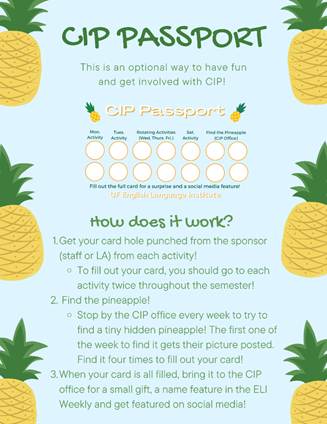
Don’t forget to get your CIP Passport hole punched from the activity leaders AT the event (not after).
We don’t hole punch passports after the event. Redeem your completed passport for a small gift, a photo for the ELI Instagram, and your name published in the ELI weekly!
Need a new CIP Passport? Stop by the CIP Office!
Find the Pineapple! The CIP Pineapple will be hidden in the ELI Main Office this semester! It will be in a new place every Tuesday morning. Stop by and find it for hole punches. The first person to find the pineapple each week will be featured on the CIP board!
Notes from the Office
Instructor Workday: Monday, September 28th is an ELI Instructor Workday. There are no ELI classes. The ELI main office will be open from 9:00am-3:00pm.
People Out: Christine will be out of the office September 28th
ELI Student Voices: There will not be a new edition of Student Voices this semester. Some of you might be excited to publish your writing, so we welcome you to submit a short article for the ELI Weekly. You can write about your experience in the US, tell about going to an ELI activity, or explain something about your country or culture. All student writers who are published in the Weekly this semester will be recognized at the Commencement Ceremony in December.
Check your I-20s: If you are traveling during the semester (for example, leaving the US and coming back), make sure your I-20 is signed. Also check the expiration date. You can make an appointment with Daryl to sign your I-20 or to renew your I-20 before it expires.
As a reminder, all people in the US on a visa should always have their I-94 with them. The I-94 is proof that you are a registered alien in the US and shows that you are here on a non-immigrant visa. You can access your I-94 at https://i94.cbp.dhs.gov/home. Contact Daryl if you cannot access your I-94.
Also, have access to copies of other important documents, like your I-20, visa, passport, letter from USCIS, or other government issued documents related to your status in the U.S.
Birthdays!
Students
None this week
Faculty/Staff
None this week

Manners & Culture
Q: Why do I have to tip in the US?
A: Tipping in the U.S. can always cause some confusion for international students and visitors. In most countries, tips are built into the bill or are not expected. However, in the US, many workers rely on tips to make their wages, so tipping is necessary!
Tipping (also called Gratuity) is expected when dining out in a restaurant in the United States. People who work in the service industry (restaurants, bars, etc.) receive only minimum wage, which is between $2-$8 per hour, and the rest of their income comes from tips.
When is tipping NOT required?
Tipping is not required for take-out food or restaurants where you go up to a counter to order (like a coffee shop or fast food places like Chipotle). However, you might see a “tip jar” on the counter and tips are certainly welcome and encouraged by the staff!
Tipping Guidelines
- Sit-Down & Full-Service Restaurant
- Standard Service: 18% to 20% of the pre-tax total for dedicated table service (taking orders, bringing food, and clearing plates).
- Exceptional Service: 25% or more for outstanding attentiveness and care.
- Large Groups: Check the bill first, as many restaurants automatically add an 18% to 20% gratuity for parties of six or more.
- Buffet Restaurants
- Standard Tip: 10% of the bill.
- Why: Servers still clear plates, refill drinks, and maintain the table area, though they provide less direct interaction than full-service dining.
- Counter Service/Fast-Casual (like Chipotle or Bolay) and Coffee Shops
- Standard Tip: Optional, or $1 to $2 (or 10% to 15%) for customized orders or exceptional friendliness.
- Why: You generally pick up your own food and clear your own tray, making tips a bonus rather than an expected wage supplement
Grammar
Q: I find it hard to understand when native speakers say contractions, like could’ve or I’ll. Do Americans ever have trouble understanding each other?
Hearing the contracted form can be tricky! In general, Americans don’t have trouble hearing and understanding contracted forms. The only time I hear people ask for clarification might be with the words can and can’t. Sometimes, it’s hard to distinguish those two words in spoken English because many of us don’t say the final ‘t’ sound very clearly.
Notes from the Editor

I need all of you, students, LAs, instructors, staff, and administrators, to help me write the Weekly! Write a paragraph about your experiences this semester. You could write about an ELI activity, a Gainesville event, a fabulous local restaurant, or tell us about a place or event in your country that we should visit. Send me grammar questions for me to put in the Weekly. Send me manners and culture questions for me to put in the Weekly. Send me jokes to put in the Weekly.
Send your paragraphs and/or questions to Christine Voigt (christinevoigt@ufl.edu) Use the subject heading: ELI Weekly.